University of Nebraska Research, Extension and Education Centers
Strategic Plan 2020-2025:
The University of Nebraska Institute of Agriculture and Natural Resources (IANR) operates three main Research, Extension and Education Centers (REEC) across the state with each having a network of farms, ranches and educational facilities to support the mission of IANR. Each REEC is unique to its own history and development since their inception. The Strategic Plan combines an in depth reflection of “looking forward” to set the direction and focus of a collaborative statewide effort. Each REEC captured input from their advisory boards as well as stakeholders and faculty to identify and prioritize needs across the state. Seven statewide “Strategic Directions” where developed during this process.
State-wide Strategic Directions:
Each REEC developed a strategic plan to contribute to the statewide strategic directions based on their geographic location, faculty expertise and resources. From these individual plans, opportunities were identified where REEC’s could combine resources and expertise to support those statewide directions. Strategic Directions:
1. Water and Nutrient management, impacting both water quality and quantity.
2. Innovative cropping systems to improve soil health, conservation, sustainability & profitability.
3. Developing resilient food animal production systems.
4. Precision agriculture for both crops and livestock.
5. Developing programing for financial resiliency of Ag producers.
6. Connecting the rural-urban interface through food, agriculture, health and science literacy.
7. Workforce development for agricultural systems.
8. Develop undergraduate and graduate experiences.
Introduction:
The University of Nebraska Institute of Agriculture and Natural Resources (IANR) at the University of Nebraska-Lincoln (UNL) was created by the Nebraska Legislature in 1973 through the enactment of LB149. This legislation followed more than ten years of discussion by state leaders and University officials in Nebraska who were concerned that agriculture was not being given proper financial support, administrative access and prominence within the University. https://ianr.unl.edu/
The Institute of Agriculture and Natural Resources consists of the three divisions, the Agriculture Research Division, Nebraska Extension and the College of Agricultural Sciences and Natural Resources (CASNR). There are twelve academic Departments in Agriculture & Natural Resources, 3 departments in Education & Human Sciences, 8 research sites located across the state and 16 multi-disciplinary centers. https://ianr.unl.edu/ianr-organizational-chart Collectively the Institute has more than 1,600 full-time employees which include 330 tenure-track faculty and 180 Extension Educators.
Nebraska Extension and the Agriculture Research Division team up to support three Research, Extension and Education Centers across the state which oversee 43,000 acres of land across the state. Each center has multiple research sites that create a unique network of areas to conduct research and extension across the state. The change in annual precipitation from the eastern part of the state to the Panhandle ranges from over 30 inches per year to 15 inches per year; with elevation ranging from 900 feet in the east to over 5,000 feet in the west. The unique cropping systems and crops grown also changes from east to west and within each of the state five agroecozones. Having research and Extension specialists with staff located at various locations across the state is a key contributor to Nebraska’s ability to provide quality Extension and research programs. The purpose of the REEC’s is to support research and Extension programing conducted by local specialists and all IANR faculty.
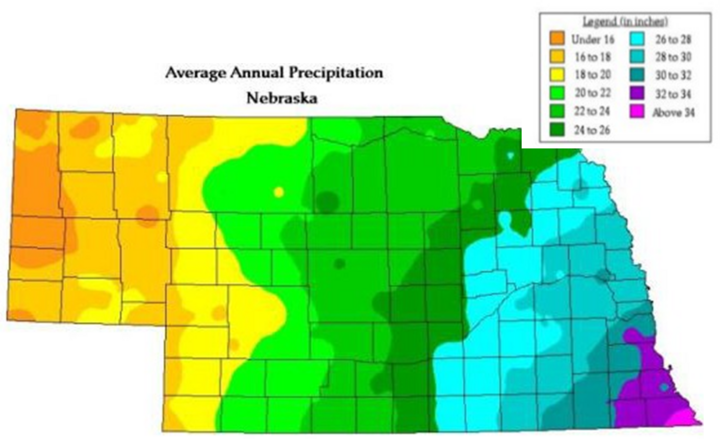
One third of Nebraska’s population of 1.9 million people live in Lincoln and Omaha with half of the population living in Lancaster, Douglas and Sarpy Counties. Eighty-nine percent of Nebraska towns have a population less than 3,000 people. Fifty percent of counties are experiencing a declining population. Four of the least populated counties in the US are located in the Nebraska Sandhills, having a population of less than 600 residents.
IANR Statewide Initiatives:
In 2011, IANR defined its focus on six communities of practice. These communities build on the strengths of cross disciplinary collaborations within the institute. The statewide initiatives that are defined can support IANR communities of practice through research and Extension programming.
- Computational Sciences
- Drivers of Economic Vitality for Nebraska
- Healthy Humans
- Healthy Systems for Agricultural Production and Natural Resources
- Science Literacy
- Stress Biology
The Institute of Agriculture and Natural Resources with Nebraska Extension, the Agriculture Research Division and CASNR are working in concert to fulfill the core aspirations of the University of Nebraska – Lincoln’s Mission for the next 25 years. The core aspirations are 1) Nebraska students co-create their experience; 2) Our research and creativity transforms lives and learning; 3) Every person and every interaction matter; and 4) Engagement builds communities. In a call to action, IANR is developing discipline specific Hubs which will work towards fulfilling these core aspirations. The
REEC’s will work to support research, Extension and teaching in the Hubs which are as follows:
- The Nebraska Integrated Beef Systems Initiative
- The Crops and Water Hub
The Rural Community Prosperity Initiative
Structure:
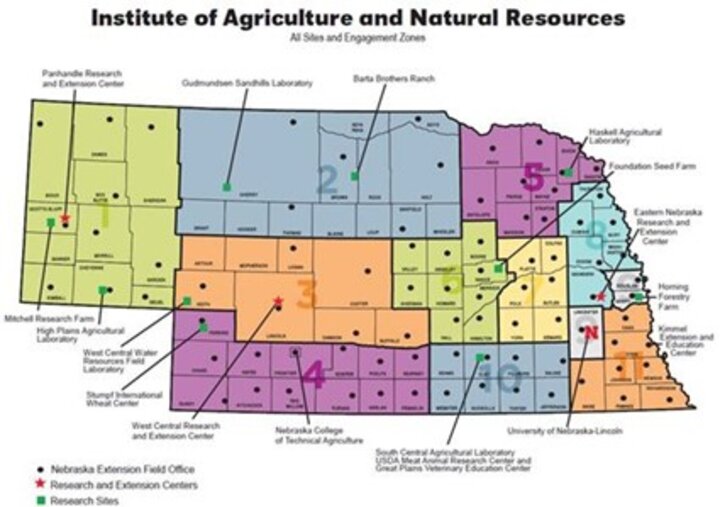
Historically the state was divided into various Research and Extension Districts which administrated research and county Extension offices. Effective January 1, 2020 the district lines went away and to administer Extension programing 11 Engagement Zones were developed. Each Engagement Zone Coordinator is responsible for the administration of the Extension educators and the county staff and operations in their zone. The Engagement Zone Coordinators report to the Dean of Extension. The three Research, Extension and Educations Centers administer the resources and facilities at their centers and connect to the educators across the state to support programing.
Facilities:
The Institute of Agriculture and Natural Resources is fortunate to have various facilities across the state to conduct research and Extension programing. Those that are administered each REEC are listed below and are shown on the statewide map of IANR facilities.
Eastern Nebraska Research, Extension and Education Center, Ithaca, NE.
The center is located within 30 miles of UNL’s East Campus and consists of 9,500 acres of crop land, pasture and livestock operations. The center also oversees the following:
- Barta Brothers Ranch, Rose, NE. A 6,000 acre ranch.
- Haskell Ag Lab, Concord, NE. A 480 acre farm for crop land and beef research facility.
- South Central Ag Lab, Clay Center, NE. A 640 acre farm for crop land research.
West Central Research, Extension and Education Center, North Platte, NE.
The center is located in a semi-arid environment in the Platte river valley and consists of 1,848 acres, which include 1200 acres of grazing pastures and 648 acres for small plot research. The center oversees the following:
- Gudmundsen Sandhills Laboratory, Whitman, NE. A 12,800 acre working ranch with 700 cows.
- Water Research Lab, Brule, NE. A 1,120 acre farm with five center pivots and two rain fed quarters.
- Henry J. Stumpf International Wheat Center, Grant, NE. A 640 acre farm in southwest Nebraska.
Panhandle Research, Extension and Education Center, Scottsbluff, NE.
The center is located on a 156 acre site for small plot research. The center oversees the following:
- Mitchell Lab site. A 269 acre cropland site and the Research Feedlot.
- High Plains Ag Lab, Sidney, NE. A 799 acre farm consisting of cropland and 1,600 acres of pasture.
Sioux County Experimental Range, Scottsbluff, NE. A 800 acre native range site.
Mission and Vision:
Statewide Research, Extension and Education Center Mission:
“Develop solutions that enhance the lives of Nebraskans through improved management of landscapes,
production systems, and resources across our state.”
The Research, Extension and Education Centers support the mission and vision of the Institute of Agriculture and Natural Resources as well as the various academic units that comprise IANR. Below are Mission and Vision statements from IANR, Nebraska Extension and the Agriculture Research Division.
The Institute of Agriculture and Natural Resources Vision:
“To serve Nebraska by providing internationally recognized science and education to assure Nebraska’s competitiveness in a changing world.”
Nebraska Extension Mission:
“Helping Nebraskans enhance their lives through research-based education.”
Agricultural Research Division Mission:
To conduct problem-solving and fundamental research that:
Addresses priority issues facing Nebraska's agriculture and food industries. Provides the knowledge base essential for managing our natural resources. Promotes family well-being and community development.
Educates future scientists through hands-on experience.
College of Agricultural Sciences and Natural Resources Vision and Mission:
Vision: “CASNR is a community where everyone challenges themselves, is inclusive, asks bold questions, co-creates and is optimistic about the future.”
Mission: “Through our collective work, we positively transform the lives of our learners, Nebraskans and our global society.”
Advisory Boards:
Each Research, Extension and Education Center hosts multiple advisory boards to provide input and direction to meet the needs of Nebraskans. Faculty are engaged and involved in state commodity boards that are relevant to their expertise. The faculty utilize local connections to stay connected to the ever-changing issues that we face.
The Institute of Agriculture and Natural Resources benefits from the support and interactions of Agriculture Builders of Nebraska, Inc. (ABN) which is a state wide not-for-profit membership organization that serves as an advisory board to IANR. The organization is dedicated to ensuring that agriculture, natural resources and food systems continue their positive roles in contributing to the enhancement of life in Nebraska through IANR teaching, research and outreach programs. Made up of over 200 representatives from agricultural industry and production fields, the group is well connected to IANR’s administration and faculty.
Statewide Strategic Direction #1.
Water and nutrient management, impacting both water quality and quantity
Goals:
- Support programing to help Nebraskans recognize interconnection between surface and ground water.
- Develop programing to increase water and nutrient use effectiveness under variable climate.
Intended Outcomes:
- Nebraska will see an improvement in water quality in both surface and ground water contaminants.
- Nebraska will improve the flow of streams/rivers in an effort to increase in the saturation of the Ogallala aquifer.
- Nebraskans will have a greater appreciation of the importance of water and nutrient use efficiency. Goal 1. Support programing to help Nebraskans recognize interconnection between surface and ground water
Key Actions | Implementation | Deliverables |
| A. Develop educational opportunities that focus on improving nutrient management | REEC Specialists UNL Specialists UNL crops and water team | Producers will understand new technologies to manage nutrient applications and take steps to use them |
| B. Prioritize programing that will allow producers to gain hands on experience with new management tools and strategies | REEC Specialists UNL Specialists UNL crops and water team | Programs will foster peer to peer connections and mentoring of technology to monitor water quality |
| C. Collaborate with Crops and Water Hub to increase awareness of sustainable landscape practices | REEC Specialists UNL Specialists UNL crops and water team | Producers will identify landscapes that are at high risk of contamination and develop strategies for conservation |
| D. Provide opportunities for water quality educational programs for urban users | Food Nutrition and Health Team Water Team | Programs will be hosted by REEC’s which engage urban audiences on water quality |
| Milestone: By 2022 establish assessment survey to quantify producer involvement in water quality and use. | ||
| Impact: Producers surveyed in 2023 will report they have taken management steps to address water quality. | ||
Goal 2. Develop programing to increase water and nutrient use effectiveness under variable climate.
Key Actions | Implementation | Deliverables |
| A. Increase collaborations with Natural Resource Districts to connect programming with producers | REEC Specialists UNL Specialists UNL crops and water team | Producers will document better conservation of water and nutrient application through survey analysis |
| B. Expand programing that promotes peer to peer learning opportunities | REEC Specialists UNL Specialists UNL crops and water team | Develop peer interactions in using technologies to make decisions on water use efficiency |
C. Provide real time water use data across REEC operations to producers | REEC Specialists UNL Specialists UNL crops and water team | Documentation of an increase in producers who utilize irrigation scheduling |
| Milestone: By 2022 50% of participants in extension programs will utilize irrigation saving techniques. | ||
| Impact: Producer survey will indicate that 75% of respondents are taking steps to improve sustainability | ||
Innovative cropping systems to improve soil health, conservation, sustainability & profitability
Goals:
- Develop innovative cropping systems research that is organized in a structure to be repeated across the five agroecozones of Nebraska to address erratic precipitation and extreme temperatures.
- Engage producers in making decisions to avoid the development of pesticide resistant species.
- Explore the development of alternative crops and varietal development.
Intended Outcomes:
- Nebraskans will gain awareness of and implement new strategies to improve farm sustainability.
- Specialists and educators will engage producers through on farm research to enhance decision making skills.
- Producers will make decisions that reduce the development of pesticide resistant species.
Goal 1. Develop innovative cropping systems research that is organized in a structure to be repeated and across the five agroecozones of Nebraska to address erratic precipitation and extreme temperatures.
Key Actions | Implementation | Deliverables |
| A. Collaborative projects will be identified by faculty that can be implemented across the state | REEC Specialists UNL Specialists UNL crops and water team | Investigators/specialists will document the results of trials across the state’s geographic regions |
| B. Engage producers on soil health and conservation projects through long term crop rotation studies | REEC Specialists UNL Specialists UNL crops and water team | Producers will understand how results of the iron farm research compare to others across the state |
| Milestone: REEC’s will identify three new projects that are connected across the state by 2023 | ||
| Impact: A better understanding of how and why crop rotations affect soil health and conservation. | ||
Goal 2. Engage producers in making decisions to avoid the development of pesticide resistant species
Key Actions | Implementation | Deliverables |
| A. Research projects will contribute to the development of decision support tools | REEC Specialists UNL Specialists UNL crops and water team | Producers will utilize tools and take appropriate steps to reduce pesticide resistant species |
| B. New learning opportunities that educate on pesticide resistant species will be developed | REEC Specialists UNL Specialists UNL crops and water team | Management tools will be adopted by farm decision makers and data shared with specialists |
Milestone: Producers involved in extension programs will report a 25% increase in identifying and implementing steps to reduce pesticide resistant species on their farms. | ||
| Impact: In five years producers will take steps to improve their management of pesticide resistant species | ||
Goal 3. Explore the development of alternative crops and varietal development.
Key Actions | Implementation | Deliverables |
| A. Expand on a robust variety testing program across the state | Crop variety testing team | Results will be presented to stakeholders to making decisions prior to the next growing season |
| B. Research demonstration and/or plots will be strategically placed across the state | REEC Specialists UNL Specialists UNL crops and water team | Recommendations for alternative crops and varieties from demonstration plots will be shared |
| Milestone: Extension will see a 25% increase of producers attending or engaging in variety field days. | ||
| Impact:50% of producers surveyed will indicate testing a new variety and or new crop on their operation | ||
Developing resilient food animal production systems
Goals:
- Develop systems for efficient and sustainable beef production.
- Contribute to the NIBSI+ Mission of a greater understanding of the interactions of G x E x M x S *.
+ (Nebraska Integrated Beef Systems Initiative) *(Genetics by Environment by Management by Social Factors)
- Integrate the next generation of management technology to beef systems.
Intended Outcomes:
- Producers will increase the productivity per unit of land.
- Nebraska beef producers will improve their decision making with the use of newly developed tools to improve rangeland health and sustainability.
Goal 1. Develop educational systems for efficient and sustainable beef production.
Key Actions | Implementation | Deliverables |
| A. Programing development will provide steps for producers to improve economy of production | UNL Beef Team Specialists Beef Educator Team | Producer will incorporate steps and identify where profitability can be increased |
| B. Teams will be formed to develop programing which documents improving beef system sustainability | UNL Beef Team Specialists Beef Educator Team | Educational venues will share products and trainings or consultations with producers |
| C. Connect with US MARC an GPVEC | REEC Directors | Provide educational platforms |
| Milestone: By 2023 50% of producers participating in extension programs will be able to document the implementation of steps on their operations for sustainable and resilient production | ||
| Impact: Producers will document an increase in resilient landscapes | ||
Goal 2. Contribute to the NIBSI+ Mission of a greater understanding of the interactions of G x E x M x S *.
Key Actions | Implementation | Deliverables |
| A. Contribute to the NIBSI genotyping protocol | REEC Directors and Specialists | Data sets will be developed which utilize genetic information |
| B. Capture environmental and management data for statewide issues | UNL Beef Team | A series of programs will educate on the interactions of G x E x M x S |
| Milestone: By 2025 UNL faculty will be utilizing data from across the state in program development | ||
| Impact: By 2025 research from all three REEC’s will contribute to data presentations and publications | ||
Goal 3. Use next generation technology and management to develop tools/strategies which aid producer decisions.
Key Actions | Implementation | Deliverables |
| A. Provide collaborative translational research projects using technology | UNL Beef Team Specialists Beef Educator Team | Increase the adoption of technology at the farm or ranch |
| B. Connect next generation, decision tools, data management, and innovative cropping systems | UNL Beef Team Specialists Beef Educator Team | Producers will partner with Educators to test new strategies both at REEC’s and on farm. |
C. Host and collaborate with statewide cover crop research | UNL Beef and Crops Team | On site research will take place |
| Milestone: By 2025 REEC facilities wil lbe utilizing multiple next generation tools to make decisions | ||
| Impact: Documentation of new tools and strategies will be presented by producer | ||
Precision agriculture for both crops and livestock
Goals:
- Develop farming and livestock precision management technologies with improved data collection systems.
- Develop research and disseminate information on precision management systems to producers.
Intended Outcomes:
- REEC’s will use infrastructure to conduct precision management will utilize and test new technology.
- Producers will be more inclined to utilize precision management tools to increase efficiency.
Goal 1. Develop farming and livestock precision management technologies with improved data collection systems.
Key Actions | Implementation | Deliverables |
| A. Identify sites for innovation centers with a focus on farm, ranch, and feedlot centers at REEC’s | REEC Directors UNL Departments UNL Specialists | New technologies will be incorporated at these sites and facilities for research and demonstration |
| B. Identify producers to provide input and direction for innovation center development | REEC Directors Educators Crops and Water Hub | Advisory teams will guide the development of innovation centers on new technologies. Producers will be identified for collaborations with Educators |
| C. Develop the capacity to collect, store and disseminate data collection for multiple research groups to utilize | REEC Directors UNL Specialists | Data bases will be developed for multiple entities to utilize data |
| Milestone: 100% of operations participating in extension programs will identify the use of one new technology that is utilized on their operations by 2023 | ||
| Impact: REEC’s will develop into interactive and informative educational sites for precision data teams | ||
Goal 2. Develop research and disseminate information on precision management systems to producers.
Key Actions | Implementation | Deliverables |
| A. Provide educational opportunities for producers to engage in hands on learning with new technologies | UNL Specialists REEC Directors and staff | Educational programs will be hosted at REEC’s to meet the key action |
| B. Develop research protocols with producers and the Crops and Water team for the collection of on farm precision management data | UNL Specialists Extension Educators Crops and Water Team | Data will be published in UNL on Farm Research Report |
| Milestone: All Extension programing will include segments on new and evolving technologies that benefit producer operational function | ||
| Impact: By 2025 50%of producers participating in Extension programing will report using one or more precision management tools on their farm or ranch which has resulted in greater efficiency | ||
Increase financial resiliency of ag producers and rural residents
Goals:
- REEC’s will collect and provide operational data for the development of farm and ranch management decision tools and cost of production parameters.
- REEC’s will provide support for UNL Specialists and Extension Educators in delivering programs to improve the profitability and sustainability of farm and ranch systems.
Intended Outcomes:
- Data generated from REEC farming and cattle operations will contribute to agricultural economic programing.
- Agricultural economic programing will reach across the state and be relevant to their geographic area. Goal 1. REEC’s will collect data for the development of farm and ranch management decision tools and cost of
production parameters.
Key Actions | Implementation | Deliverables |
A. Hold roundtable discussion with Ag Econ Team, Beef Team and Crops &Water Team | REEC directors | Identify three key areaswhere collaboration take place |
| A. Mechanisms will be put in place to collect cost of production | REEC Directors Ag Econ Specialists &Educators REEC Farm Managers | Cost of production datawill be collected for each REEC agricultural enterprise |
B. Cost of production will be recorded and shared for benchmarking | REEC Directors Ag Econ Specialists &Educators REEC Farm Managers | Data will be utilized to contribute to the Agricultural Economics Farm Management group |
Milestone: REEC’s will collectand develop a real timedata set of unit costof production for UNLemployees to utilize by the end of 2021 | ||
| Impact: Greater connections to Ag Economics regional educators and campus-based specialists will be developed | ||
Goal 2. REEC’s will provide support for UNL Specialists and Extension Educators in delivering programs to improve the profitability and sustainability of farm and ranch systems.
Key Actions | Implementation | Deliverables |
| A. REEC’s will provide land and facility resources for specialists and educators to deliver programming | REEC Directors | Land and Animals will be available for Agriculture Economic programing to be delivered across the state |
| B. REEC’s will work with local advisory groups to identify priority needs for Nebraska agriculture producers | REEC Directors Ag Econ Specialists Regional Ag Econ Educators Extension Educators | The Agricultural Economics Group will lead efforts in providing programing around priority areas |
| C. REEC’s will utilize economic decision support tools developed by Farm Management Team | REEC Directors REEC Specialists | Farm Management Team will receive input from REEC operations concerning tools |
| Milestone: REEC’s will collect data and contribute to the development of decision support tools to assess production practices across the state | ||
| Impact: By 2025 Research collaborations will result in published findings and presentations | ||
Connecting the rural-urban interface through food, agricultural, health and science literacy
Goals:
- REEC’s will collaborate with specialists, extension educators and IANR teaching faculty to develop and produce science based agricultural educational programing for youth and adults.
- REEC’s will enhance their facilities to become living learning centers for agricultural literacy programing.
Intended Outcomes:
- Nebraskans will have an understanding of the complexity and interconnectedness of the agroecosystem.
- Nebraskans will have increased consumer confidence with the ability to make science informed decisions when making personally and socially relevant decision concerning food, energy, health and policy.
Goal 1. REEC’s will collaborate with specialists, extension educators and IANR teaching faculty to develop and produce
STEM based food, agricultural, health and science literacy programing for youth and adults.
Key Actions | Implementation | Deliverables |
| A. REEC’s will utilize current programing and develop new programing for youth using facilities and mobile resources | Extension Educators UNL Specialists | 1 out 3 students will participate in programs That connect them to agriculture and food production |
| B. Provide programing that connects students to agricultural careers | Extension Educators UNL Specialists | Students will identify at least three different agriculture careers paths related to agriculture |
| C. REEC’s will provide internship opportunities for students desiring to gain agricultural experience | REEC Directors REEC Specialists | REEC’s will make a commitment to provide a minimum of 2 internships which provide learning experiences in at least two agriculture areas |
| Milestone: Currently 1 of 3 students is involved in 4-H programing. REEC will contribute to reaching students with programing and by 2022 and will have an educational program to enroll students in. | ||
| Impact: REEC’s will further develop and define the “Educational” component of their operation | ||
Goal 2. REEC’s will become living learning centers for food, agriculture and health literacy programing.
Key Actions | Implementation | Deliverables |
| A. REEC’s will identify and develop places of learning for youth and the public in collaboration with specialists and educators | REEC Directors UNL Specialists Extension Educators | Each REEC will provide two learning exhibits/stations that will be open to the public providing key practices that occur in each region |
| B. Enhance Web based educational materials | Extension Educators UNL Specialists | Videos, podcasts etc. will be developed for discipline areas at each REEC |
| C. Provide opportunities to connect clientele to programs for urban adult learners in areas beyond agriculture programing | Extension Educators UNL Specialists | Expand program offering to industry and policy decision makers; Provide spaces to develop programing for Buy Fresh Buy Local, Health Living and Mental Wellness |
| D. Identify programing specific to underserved audiences | REEC Directors Reaching One Reaching All | Measurable impacts will be quantified in reaching underserved populations |
Milestone: By 2025 Each REEC will have facilities and spaces that engage youth and adults in food, agriculture and health literacy | ||
| Impact: Greater collaborations between REEC specialists with educators and campus-based specialists will be documented | ||
Workforce development for agricultural systems
Goals:
- Create educational opportunities for Nebraskans to receive continuing education training to improve their skills by identifying specific areas that REEC’s can contribute to workforce development in their region.
- Provide credentialing for program completion with single and stackable digital badging options.
Intended Outcomes:
- Improvement in the “Education and Skill Index” for the Nebraska Thriving Index.
- Increase credentialing for those seeking documented completion of educational programs.
- Improvement in the population “Demographic Growth and Renewal Index” of the Nebraska Thriving Index.
Goal 1. Create educational opportunities for Nebraskans to receive continuing education training to improve their skills by identifying specific areas that REEC’s can contribute to workforce development in their region.
Key Actions | Implementation | Deliverables |
| A. Form collaboration with Blue Print Nebraska to identify workforce needs unique to the location of each REECC in the state | REEC Directors | Each REEC will identify two workforce needs that is applicable to their region and create educational and work force training programs |
| B. Develop Programming for Nebraska’s workforce needs which results in credentialing | REEC Directors | Participants will receive documentation such as a digital badge for completion of program |
| Milestone: By 2023 Each REEC will have a signature program which contributes to workforce development | ||
| Impact: New educational credentialing programs will enhance stakeholder’s competitiveness in the job market | ||
Goal 2. Provide credentialing for program completion with single and stackable digital badging options.
Key Actions | Implementation | Deliverables |
| A. Identify programs for credentialing by surveying stakeholders and educational leadership | REEC Directors | REEC’s will use advisory groups to identify 2-3 key programs where workforce training can be conducted for certification |
| B. Develop credentialing with digital badges for programs which will be utilized by participants in collaboration with CASNR | REEC Directors Specialists & Educators | Documentation of training for those seeking continuing education and developing skills for future endeavors |
| C. REEC’s will initiate conversations with educational institutions for potential programs | REEC Directors | Each REEC will identify a program that can be collaborated with an educational institution |
D. REEC’s will develop partnerships with H.S. Agricultural Education Programs | REEC Directors Specialists & Educators | Each REEC will develop an educational program with a regional High School FFA program |
| Milestone: By 2023 each REEC will contribute expertise in the development and support of a program that results in a form of credentialing for secondary and post-secondary students as well as non-degree seekers | ||
| Impact: By 2025 successful completion of programing resulting in career advancement will be documented | ||
Develop undergraduate and graduate experiences
Goals:
- Create educational opportunities for students to gain experience in research and Extension.
- Develop learning spaces where students can engage in learning opportunities beyond the classroom.
Intended outcomes:
- Students will graduate with higher level experiences through engagement and critical thinking.
- Students will be sought after by employers.
Goal 1. Create educational opportunities for students to gain experience in research and Extension.
Key Actions | Implementation | Deliverables |
| A. Collaborate with CASNR to create opportunities for students at each of the REEC facilities | REEC Directors CASNR Dean’s office | Students across multiple majors will have opportunities to engage in learning experiences at REEC’s |
| B. On campus classes will have opportunities to engage in REEC facilities through tours, specialists’ interactions and case studies | REEC Director REEC Specialists, | Campus basked faculty will have opportunities to engage with specialists and staff at each REEC to support learning outcomes |
| Milestone: By the summer of 2021 summer experiences will be set up for students at each REEC | ||
| Impact: Students will report positive increases in critical thinking and understanding of agriculture research | ||
Goal 2. Develop learning spaces where students can engage in learning opportunities beyond the classroom.
Key Actions | Implementation | Deliverables |
| A. Identify experiences for students at each of our research facilities | REEC Directors | Each facility will have students engaged in research learning activities |
| B. Provide opportunities for entrepreneurs to collaborate with REEC Faculty | REEC Director WCREEC Specialists, Rural Prosperity Educators | New collaborations will be developed to engage aspiring entrepreneurs in areas including food production and business development |
| Milestone: By January 2021opportunities for students will be advertised through CASNR | ||
| Impact: Students engaged on off campus learning opportunities will report gains in experience and exposure to current agriculture issues | ||